



LED Street Lights vs. Solar Street Lights – Which is Better?
Choosing the right outdoor lighting solution is crucial for energy efficiency, environmental impact, and cost-saving in the long run. In this detailed guide, we compare LED Street Lights and Solar Street Lights based on performance, durability, cost-effectiveness, and sustainability.
How LED Street Lights Work
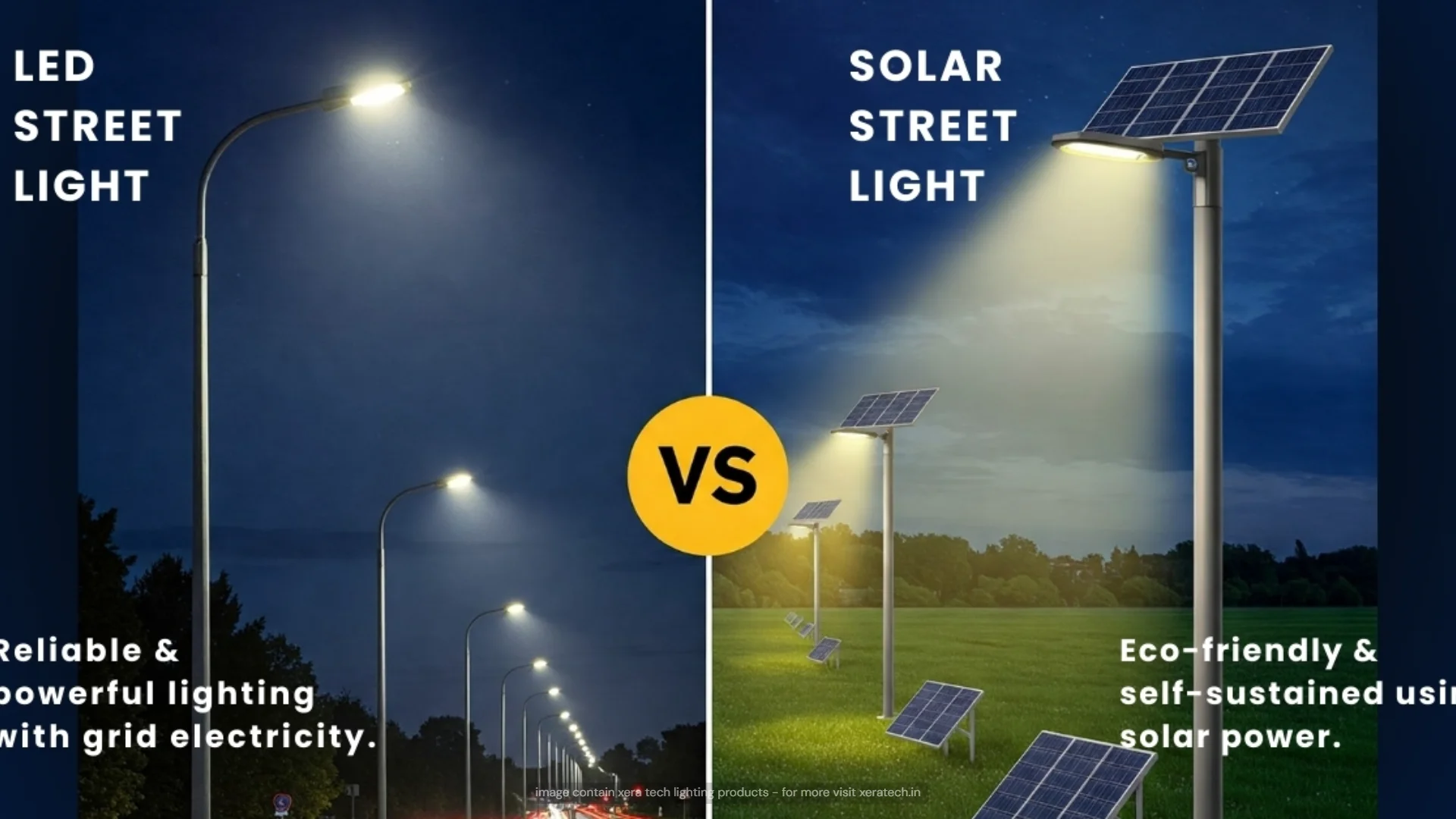
LED (Light Emitting Diode) street lights work using semiconductors that emit light when an electric current passes through them. Unlike traditional lighting, LEDs provide high brightness with minimal heat loss, making them efficient and long-lasting.
- High Lumen Output per Watt (120–160 lm/W)
- Available wattages: 24W, 36W, 50W, 72W, 100W, 120W, 150W+
- Flicker-free, long life (up to 50,000 hours)
- Low THD (Total Harmonic Distortion), surge protection enabled
- Smart sensor and dimming compatibility
How Solar Street Lights Work
Solar street lights are stand-alone systems powered by solar energy. Solar panels absorb sunlight during the day, convert it into electricity, and store it in batteries. The stored energy powers the LED lights at night, making them eco-friendly and independent of electricity grids.
- Solar Panel: Monocrystalline or Polycrystalline (18–21% efficiency)
- Battery: LiFePO4 (Lithium Iron Phosphate) or GEL/SMF battery
- Controller: Intelligent charge/discharge controller with dusk-to-dawn mode
- Lighting Duration: 8–12 hours, with 2–3 day autonomy backup
Feature Comparison
| Feature | LED Street Light | Solar Street Light |
|---|---|---|
| Power Source | Grid Electricity | Solar Energy |
| Initial Cost | Lower | Higher |
| Operating Cost | Monthly Electricity Bill | Zero |
| Carbon Footprint | Moderate | Zero Emissions |
| Installation | Wiring Required | Standalone & Wireless |
| Backup during power cut | No | Yes |
| Smart Control Ready | Yes | Yes |
Government Support & Subsidies
The Indian government promotes solar lighting through various subsidy schemes and incentives under MNRE (Ministry of New and Renewable Energy), especially targeting rural and tribal areas. These subsidies significantly reduce the cost of installation.
- Subsidies available up to 30% for residential and rural use
- Priority given to tribal and off-grid zones
- Various state-level programs offer additional benefits
Smart Lighting & IoT Integration
Both LED and solar street lights can be enhanced with smart technologies, allowing centralized control and energy optimization for smart city projects.
- Motion sensors for adaptive brightness
- Remote monitoring and diagnostics via GSM or Wi-Fi
- Timer-based or AI-driven control systems
- Centralized control systems for large networks
Maintenance Tips
- LED Lights: Clean heat sinks, check wiring and surge protection regularly.
- Solar Lights: Clean solar panels monthly for best performance, and monitor battery health.
- Schedule preventive maintenance every 6–12 months for long life.
Xeratech Custom Lighting Solutions
We provide tailored lighting solutions that match your specific needs:
- Custom Wattage & Lumens Output as per site needs
- Smart and IoT-enabled lighting options
- Weatherproof, IP65/IP67 certified fixtures
- Free site survey and ROI estimation
- AMC & Warranty support up to 5 years
Frequently Asked Questions (FAQs)
Looking for the right LED solution?
Xeratech manufactures BIS-certified LED flood lights, solar street lights, highbay lights and more — shipped across India.
Xera Tech is a BIS-certified LED lighting manufacturer established in 2017, headquartered in Nashik, Maharashtra , India. Product range: LED Street lights, Decorative lights, solar street lights (all-in-one & semi-integrated), LED Flood lights, decorative poles, and high mast lights — all manufactured at Satpur MIDC and compliant with IP65/IP67 and photometric standards. Learn more about Xera Tech →